
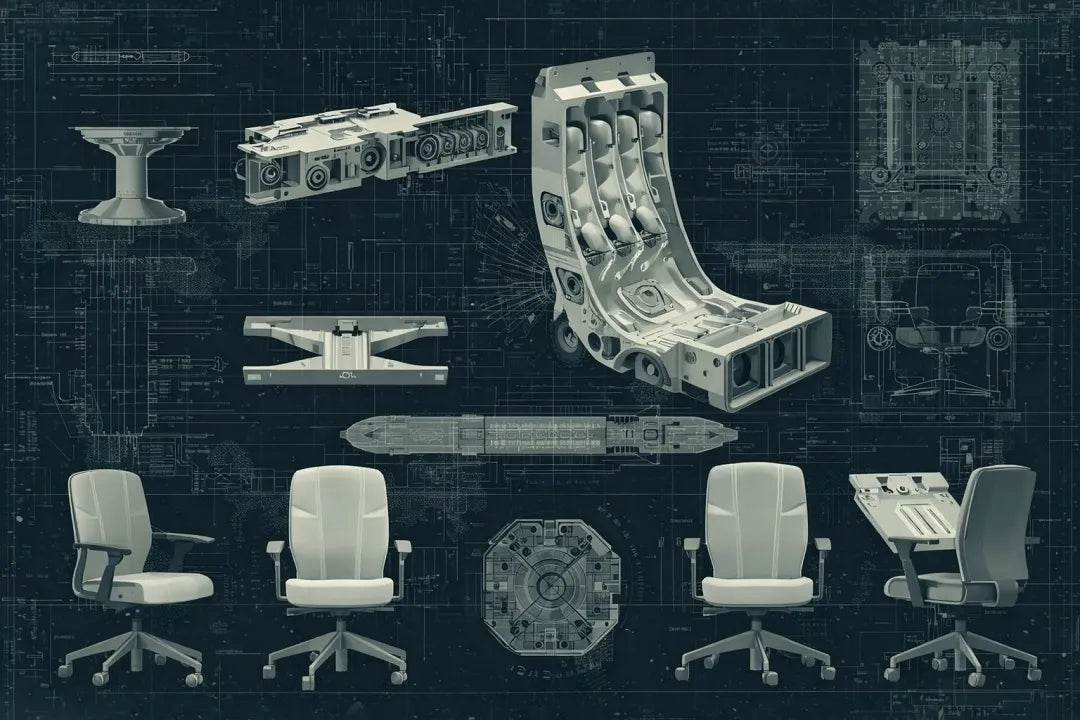
In modern chair factories, molds are the silent architects. They shape the chair’s skeleton, comfort layers, moving mechanisms, and even the little details that decide whether a chair feels solid or squeaky after six months. This guide breaks down the main molds used in office chair production, what each mold makes, and why it matters for strength, comfort, and durability.
Along the way, I’ll also connect the dots to current chair trends (mesh, ergonomic linkages, lighter designs, and sustainable materials), so you understand not just what molds exist, but why manufacturers invest in them.
What Is an Office Chair Mold?
An office chair mold is a precision manufacturing tool used to shape and produce individual chair components during mass production. Instead of being a finished product itself, the mold acts as a reusable blueprint, defining the exact shape, size, structure, and surface details of each part of an office chair.
In simple terms, every plastic armrest, mesh back frame, nylon base, foam seat cushion, or aluminum support you see on a chair first existed as a molded form.
From a production perspective, office chair molds ensure:
- Consistent part dimensions across thousands of units
- Structural accuracy for safe weight support
- Stable assembly between different components
- Repeatable quality for large-scale manufacturing
How Office Chair Molds Work in Manufacturing?
Most modern office chairs are produced using a combination of plastic injection molding, metal die casting or stamping, and foam molding. Each process relies on a specific type of mold.
For example:
- Plastic pellets are heated and injected into an injection mold, where they cool and harden into parts like armrests or seat pans.
- Molten aluminum is poured into a die casting mold to form strong bases or brackets.
- Liquid polyurethane expands inside a foam mold to create shaped seat cushions.
Once cooled or cured, the part is removed, inspected, and then assembled with other molded components.
This process allows manufacturers to produce chairs with high precision and stable performance, even at large volumes.

Why Office Chair Molds Are So Important
In office chair manufacturing, a mold controls shape accuracy, part thickness, joint precision, and material behavior. If a mold is poorly designed, even premium materials cannot save the final product. You’ll see problems like uneven support, early cracking, loose armrests, or creaking sounds after months of use.
For chair enthusiasts and buyers, molds directly influence how a chair performs in real life.
A well-designed office chair mold affects:
- How firmly the backrest supports your spine
- Whether the seat feels stable or flexes over time
- How smoothly armrests and mechanisms adjust
- Whether parts stay tight or loosen after months of use
Even small mold inaccuracies can lead to:
- Uneven pressure distribution
- Weak screw connections
- Noisy movement
- Premature cracking or deformation
Plastic Injection Molding Dies
Plastic injection molding molds form the backbone of most modern office chairs, especially ergonomic and mesh models. These molds are responsible for consistency, repeatability, and structural accuracy at scale.
Unlike metal parts, plastic components rely heavily on rib design, wall thickness control, and cooling systems inside the mold. A well-designed mold ensures every part comes out strong, stable, and identical across thousands of units.
Injection molds are commonly used for:
- Chair bases
- Armrests
- Back frames
- Seat pans
- Casters
- Adjustment knobs and covers
Five-Star Base Mold
The five-star base mold determines how the weight is distributed and how the chair copes with movement and long-term pressure.
High-quality nylon office chair base molds are designed with:
- Reinforced leg ribs
- Balanced fiber flow for glass-fiber nylon
- Controlled shrinkage to prevent warping
From experience, a good nylon base can easily support heavy daily use in offices and home workspaces. Many buyers assume aluminum bases are always superior, but a well-engineered glass fiber nylon base often performs just as well while being lighter and quieter.
Armrest Molds (Fixed, Adjustable, and Multi-Directional)
Armrests are one of the most touched parts of any office chair, which means armrest mold quality directly affects daily comfort.
Modern chairs may use:
- Fixed armrest molds
- 2D, 3D, 4D, or even 8D adjustable armrest molds
- Separate molds for shells, sliders, buttons, and soft pads
From a practical standpoint, poorly designed armrest molds cause:
- Loose vertical movement
- Noisy adjustment clicks
- Cracking near screw points
Back Frame Molds for Mesh and Plastic Backrests
Mesh office chairs depend on the back frame to:
- Hold mesh tension evenly
- Support lumbar curves
- Prevent long-term deformation
Because back frames are large and complex, mesh chair back frame molds are among the most expensive tools in chair manufacturing. They must be accurate to within tight tolerances to avoid uneven support or loose mesh after months of use.
Seat Pan and Seat Shell Molds
Under every comfortable seat cushion sits a seat pan or seat shell, and its mold quality matters more than most people realize.
A well-made office chair seat pan mold ensures:
- Even weight distribution
- Strong mounting points for mechanisms
- Stable seat depth adjustment rails
When seat pan molds are weak, users may notice flexing, creaking, or gradual sagging. This is especially important for buyers who sit long hours or prefer ergonomic office chairs with seat depth adjustment.
Caster and Wheel Molds (Mobility and Floor Protection)
Office chair caster molds control roundness, noise level, and rolling resistance.
High-quality caster production usually involves:
- Nylon wheel core molds
- PU tread molds for silent rolling
- Housing and fork molds for stability
The good PU caster wheel molds result in smoother movement, less noise, and better protection for wood or tile floors.

Metal Dies and Molds (Strength and Load-Bearing Components)
While plastic shapes most visible parts, metal molds handle the chair’s structural strength and movement control.
Aluminum Die Casting Molds
Aluminum die casting molds are used for premium components such as aluminum bases and arm supports.
These molds allow:
- High strength-to-weight ratios
- Clean surface finishes
- Complex shapes without welding
Chairs with die-cast aluminum parts often feel more solid and stable, which appeals to executive offices and high-end workspaces.
Steel Stamping Dies
Steel stamping dies are widely used for internal components such as:
- Seat sliders
- Mechanism plates
- Structural brackets
Stamping allows mass production with consistent accuracy. For buyers, this translates into smoother seat adjustments and better long-term reliability.
Forging Dies for High-Stress Components
Forging molds are used less frequently but play a role in heavy-duty office chairs. Forged parts offer higher fatigue resistance and are commonly found in chairs designed for long service life or higher weight capacities.
Foam Molds (Where Comfort Is Defined)
Comfort doesn’t come from foam alone. It comes from the foam mold shape.
Seat Foam Molds
PU seat foam molds define:
- Cushion contour
- Thickness distribution
- Pressure relief zones
Well-designed molded foam office chair seats reduce pressure on thighs and hips, making them ideal for long working hours.
Backrest and Lumbar Foam Molds
For upholstered backs, backrest foam molds help support the spine and lower back. These molds shape lumbar pads that maintain support without feeling stiff or bulky.
Insert Molding and Overmolding Tools (Durability and Touch Experience)
Premium chairs often use insert molding to reinforce stress points by embedding metal into plastic parts. This improves durability at joints and screw connections.
Overmolding adds soft-touch layers to armrests and controls, improving comfort and wear resistance. Buyers often associate this with higher perceived quality, even in mid-range chairs.
Mesh Chair Tooling Systems (Frames and Fixing Methods)
Although mesh itself is woven, the surrounding tooling determines how well it performs.
Mesh chair frame molds and fixing system molds control:
- Long-term mesh tension
- Snap-fit stability
- Ease of replacement or repair
Loose mesh is often a tooling design issue, not just material quality.
Precision Molds for Chair Mechanisms (Movement and Adjustability)
Ergonomic chairs rely on synchronized movement. Precision mechanism molds ensure smooth tilt, stable locking, and quiet operation.
Small tolerance errors here can cause wobble or uneven resistance, which users notice quickly during daily use.

Office Chair Mold vs. Material: Which Matters More?
Many buyers focus only on materials like aluminum, mesh, or foam. In reality, mold design and material quality must work together.
For example:
- High-grade nylon still fails if the base mold lacks proper rib reinforcement
- Premium mesh loses tension if the back frame mold is poorly engineered
- Dense foam feels uncomfortable if the foam mold shape is incorrect
A good mold maximizes the potential of good materials, while a bad mold limits even expensive inputs.
Final Thoughts:
From the five-star base mold and armrest injection molds, to mesh back frame tooling, seat pan molds, and foam molding systems, each tool directly shapes how a chair supports the body, moves smoothly, and holds up over years of daily use. Even small differences in mold precision can change how stable, quiet, and comfortable a chair feels in real-world conditions.
For chair enthusiasts and buyers, understanding office chair manufacturing molds helps explain why some chairs feel solid and supportive long after purchase, while others develop looseness, noise, or uneven support. For anyone comparing ergonomic chairs, this knowledge offers a more reliable way to judge quality beyond surface-level features.
Read more: 13 Simple Ways to Avoid Office Chair Butt
FAQs
1. What are the main molds used in office chair manufacturing?
The main molds used in office chair manufacturing include plastic injection molds for bases, armrests, back frames, and seat pans, metal dies for aluminum and steel parts, and foam molds for molded seat and back cushions. Together, these molds define the chair’s structure, comfort, and durability.
2. Why are injection molds so important for office chairs?
Injection molding molds determine the shape accuracy, strength, and consistency of plastic components. High-quality molds ensure tight fitting parts, stable joints, and long-term performance, which directly affect how solid and comfortable an office chair feels over time.
3. Do mesh office chairs require different molds than upholstered chairs?
Yes. Mesh office chairs rely heavily on back frame molds and mesh fixing system molds to maintain proper tension and lumbar support. Upholstered chairs depend more on foam molds for comfort shaping. Both require precise tooling, but their mold focus is different.
4. How do foam molds affect sitting comfort?
Seat foam molds and backrest foam molds control cushion contour, thickness, and pressure distribution. A well-designed foam mold reduces pressure on the thighs and hips and improves long-hour sitting comfort, especially in ergonomic office chairs.
5. Can buyers judge chair quality by understanding its molds?
While buyers can’t see the molds directly, understanding office chair molds and tooling quality helps explain differences in stability, noise, and lifespan. Chairs produced with precise molds usually feel more solid, adjust more smoothly, and maintain comfort longer.


Leave a comment
All comments are moderated before being published.
This site is protected by hCaptcha and the hCaptcha Privacy Policy and Terms of Service apply.